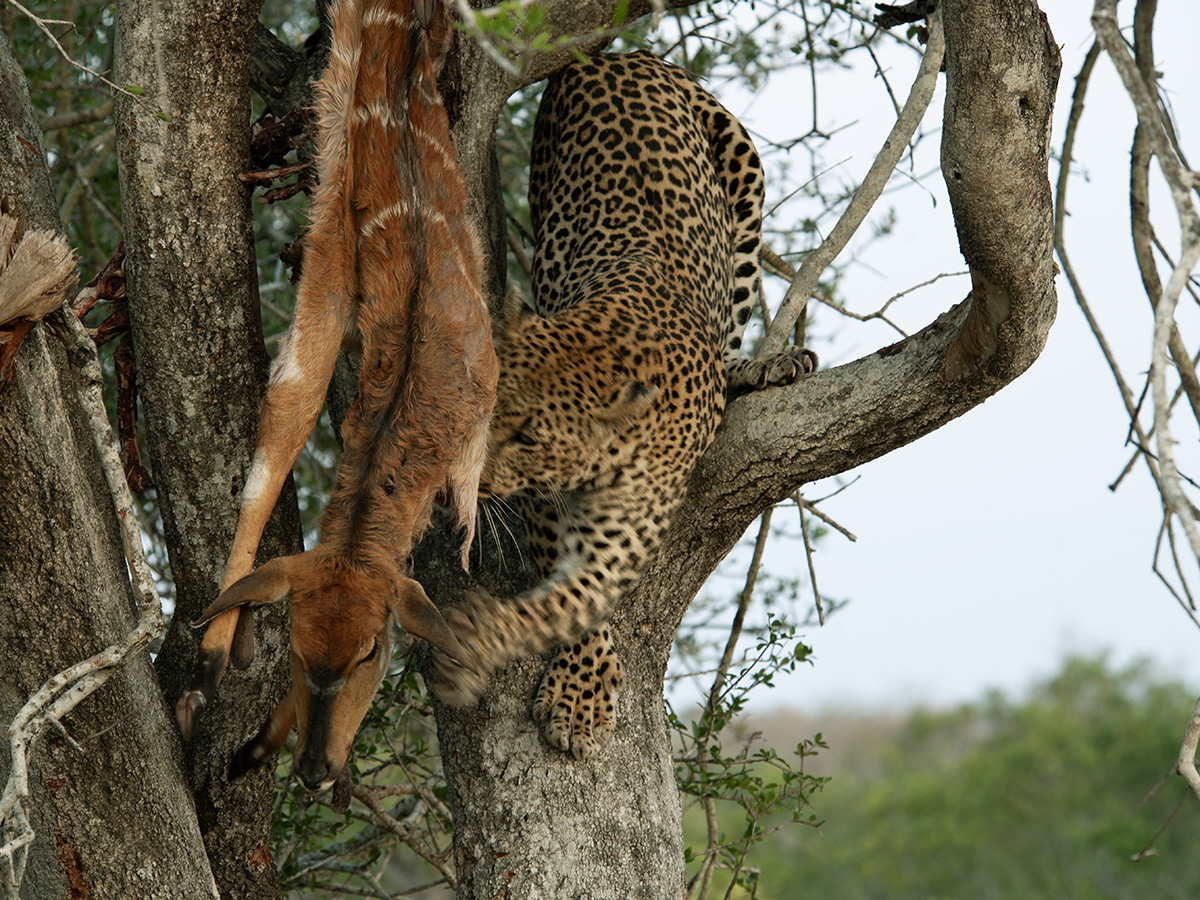
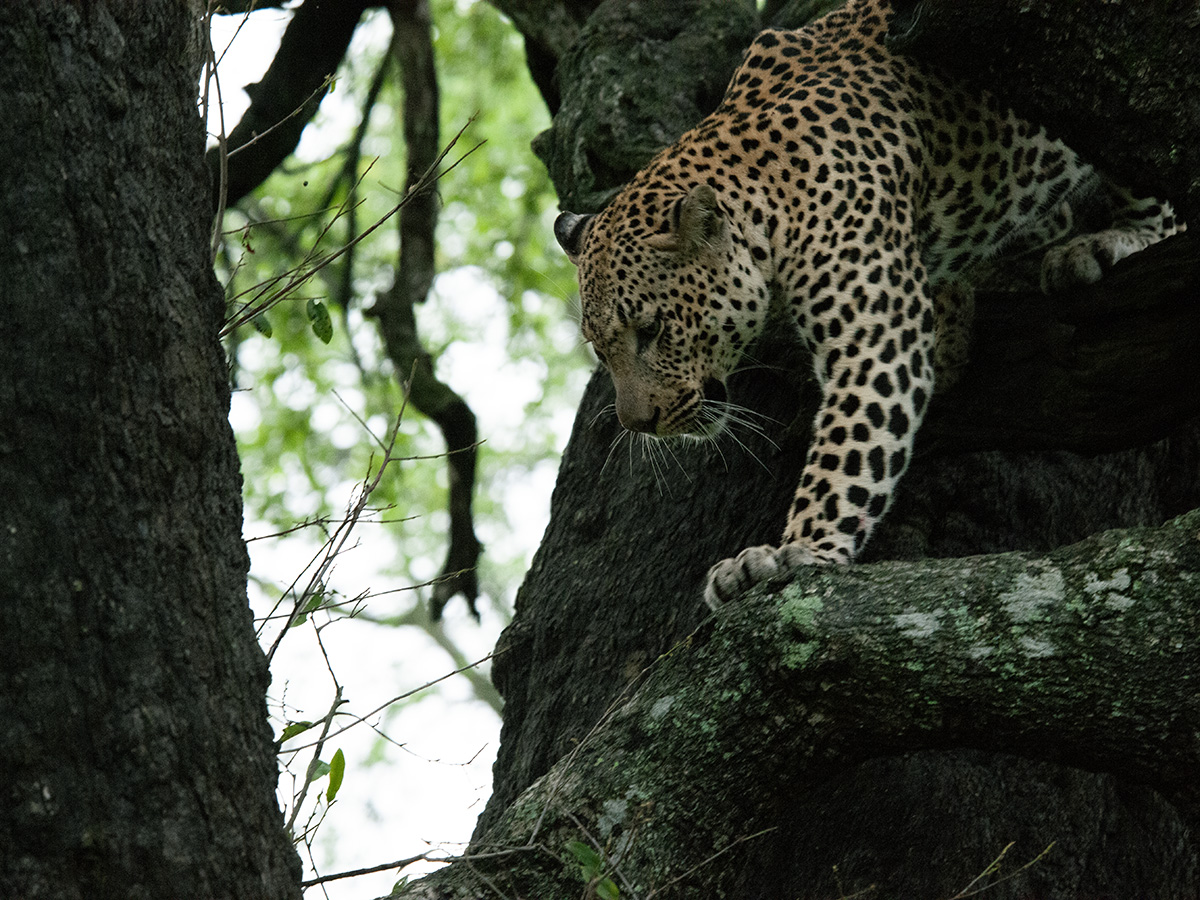
Leopards prefer to hoist their kills into trees to keep them safe from other predators like lion and hyena. There is not always a good choice of trees nearby and the closest tree can turn out to be an unfortunate option for navigating the branches with a kill. This male leopard had hoisted his kill into a difficult tree with lots of small branches. As he was trying to find a good position for his kill, a Nyala antelope, to feed on, a leg of the Nyala got hooked on a branch, making it impossible to move. He tried to free it by pulling and pulling, but it stayed put. He tried pulling from different angles, as much as the tree allowed, but the leg stayed hooked. When he got tired, he came down and rested at the bottom of the tree in the grass. When he felt he could try again, he went up in the tree and continued pulling, but it wasn’t moving. The tree with its lots of small branches was not only difficult for storing a kill, it was also difficult to move around and when the leopard tried to shift his position while pulling the Nyala, he missed a branch and fell off the tree while still holding on to the Nyala. He did not let go. He was holding on to the Nyala, dangling from the tree, just above the ground. And the Nyala stayed hooked on the branch, even this fall and the weight of the leopard did not free it. The leopard, while dangling above the ground, pulled himself up the Nyala in an attempt to pull even in this position, but it did not move. He needed to catch his breath and let go, resting in the grass. But not for long. He stood up and pulled himself up the Nyala again, but to no avail. He changed tactics, climbed up into the tree and pulled the dangling Nyala to one side where he could hold it and feed. It was not ideal, but he could continue feeding. This unfolded over several hours and it took the male leopard until the evening to finish his kill until only bones and skin were left with the leg still hooked on the branch.
11/03/26 10:30
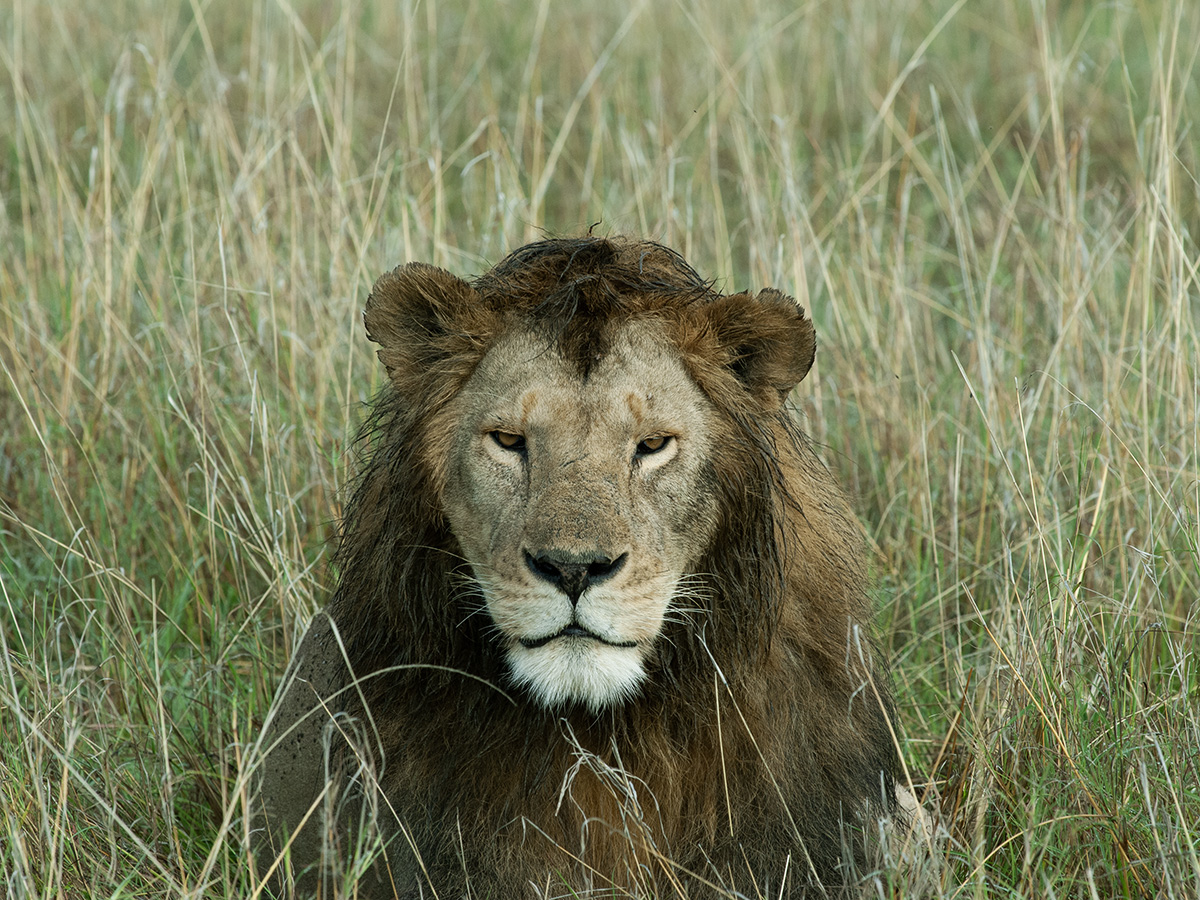
Although lion are big strong cats and have the advantage of hunting as a pride, it is still not easy to hunt successfully. On a morning on the plains of the Serengeti a herd of zebras was wandering at a casual pace towards a waterhole. Between them and the waterhole a pride of lion had been lingering, waiting for whatever would come along that could be an opportunity to hunt. It was a big pride with cubs of different ages playing in the high grass. When the females saw the zebras heading their direction they silently signalled that all had to go down and hide in the grass. And suddenly there were no lion to be seen anymore. The zebras wandered towards the lion with the stallions in front. Suddenly one stallion stopped and with him the rest of the herd. He was about 100 meters (about 300 feet) away from the hiding lion. He took in the air and seemed to be hesitant what to do, sensing something was not right, but he just stood there for a while undecided what to do. The lion didn’t move, they were lying low, no lion to be seen. It was just quiet, the zebras stood there not knowing what to do, the lion waited. After several minutes of waiting and watching, suddenly a male lion head popped up from behind the hiding pride. The male lion appeared to have been sleeping away from the pride and woke up wondering where everyone was. Now the zebra knew what was waiting for them and they slowly turned around and moved away in the direction where they came from. The heads of the females and cubs popped up now and one subadult lion cub went to chase the zebras, but nobody was joining him, the distance was too big and the females knew it would be a waste of energy to try to get to the zebras. And the zebras knew they don’t need to run too. Nobody wanted to waste energy, as they all might need that energy for something that could come up the next moment. And for the lion the day became eventful. Their position near the waterhole brought them shortly after the missed hunt a new opportunity. A herd of buffalos was approaching the waterhole from the other side. The female lion moved to position themselves in teams of two on termite mounts. The cubs were brought to further away trees to be out of the way. Buffalos are of a different kind of danger than zebras. The buffalos took their time at the waterhole and the lion waited at their positions patiently. If the buffalos would move in their directions, the lion would be positioned well to give it a try. Unfortunately for the lion, after about an hour the buffalos decided to move in the opposite direction. The lion left their posts and the pride lingered further in the grass with the cubs playing again. Only a bit later a herd of elephants came along and the lion didn’t even have a thought that could be a hunting opportunity. The elephants went straight for the lion and chased them away from their nice place near the waterhole. There was no luck for the lion that day, but they were wisely saving their energy, as they might have also no luck the next day and need to manage a bit longer without food.
09/02/26 16:31
Leopards are considered to be solitary animals, but they only are to some extend. On private game reserves where leopards have been observed for decades, interesting interactions have been witnessed. Male leopard territories overlap the territories of several females, how many females depends on the size of the male’s territory, which depends on his strength of keeping other males away. The females in a male’s territory are mostly not related. Usually an adult cub moves away to establish a territory elsewhere. However, some females stay in the area and some take over part of their mother’s territory. This specific leopard family situation was unusual. The mother and daughter had neighbouring territories, partially overlapping. They had decided that the mother would look after one of the daughter’s two cubs, which would increase the chances of survival for both cubs. The daughter supported her mother in the care of the cub with food. The male leopard and father of the cubs met with them regularly, sometimes all of them were in the same tree. When the male cub raised by the grandmother became an adult, he was not forced out of his father’s territory, as it would normally be the case. His father allowed him to stay, possibly to help control it. It could also have played a role that the grandmother was at that time very old and they might have anticipated on her passing and a reshuffle of territories. Either way, what this example shows is that leopards interact more with each other than often thought. In some areas these usually illusive animals can be observed more closely and more can be understood about their social behaviour.
11/01/26 18:31
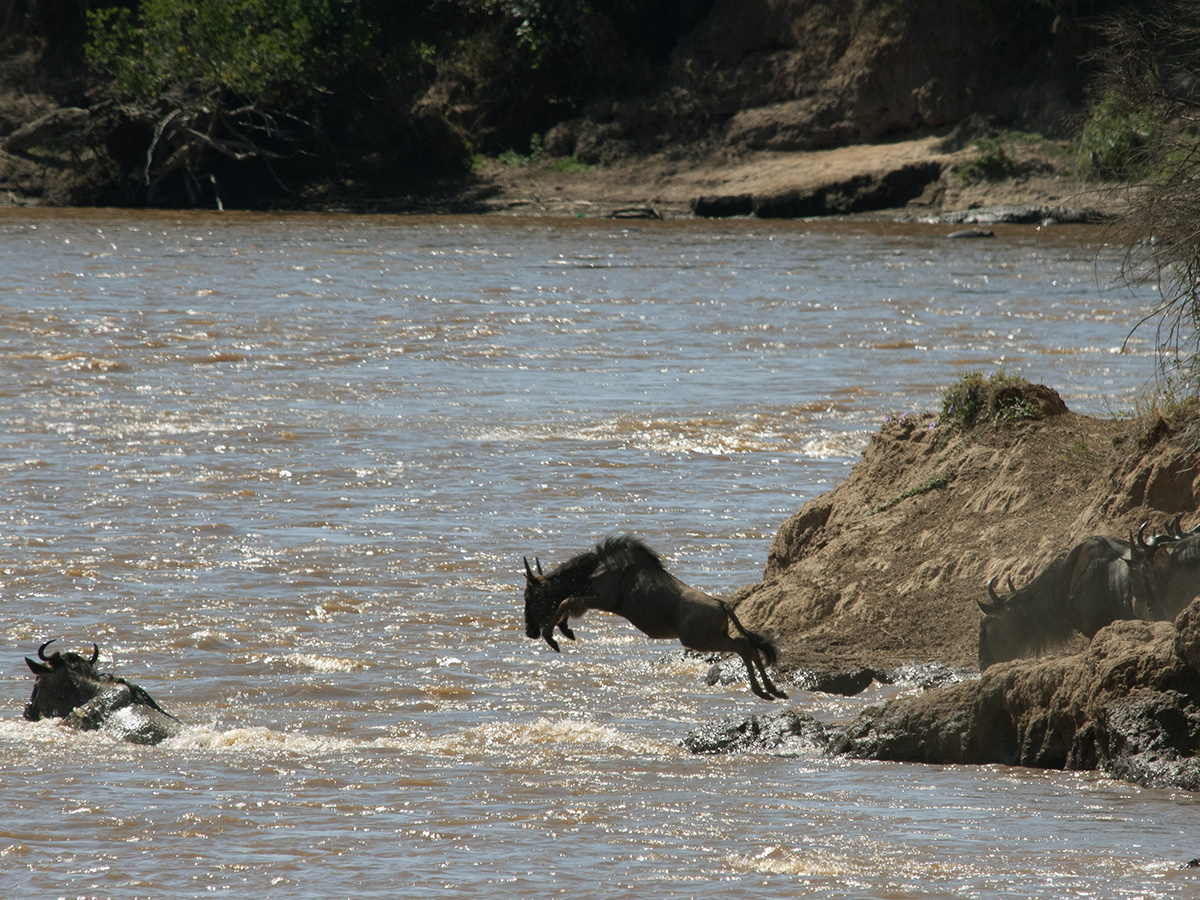
When wildebeest are crossing the Mara River the air is filled with their calls and their tension is almost tangible. They gather, feed and rest before starting to cross. They know it needs strength to get to the other side and they need safety in numbers. They attempt to cross in single file, one animal right after the other to let them appear as one animal to the crocodiles, trying to make it harder for the crocodiles to single out a wildebeest for an attack. This strategy is challenged by the obstacles they encounter. The entry and exit points are slippery and rocky and during low water levels there are exposed rocks in the river they need to navigate. The more animals have crossed the more muddy and treacherous the exit points become and animals get stuck, blocking others from getting out. Dramatic scenes can unfold, yet the animals find ways to care for each other. When an exit becomes blocked or too difficult to navigate they change directions, which releases the pressure on the animals that are already in these exits, giving them the space to reassess the situation and find a way to get up on the river bank. Animals that got stuck in the mud get a chance to free themselves and make it out. This footage is witness to how the wildebeest take pressure of an exit point where two animals, a mother and a youngster are stuck in the mud and how the other animals, once the pressure has been released, take a moment to check with them and try not to step on them while trying to get out and out of the way. Both, mother and youngster made it out.
14/12/25 12:41
On a sunny summer day this male leopard was resting in the grass at the bottom of a tree. Up in the tree he had stashed his kill. He was lying on his side, looking like he was sleeping.
A female leopard was approaching from behind, thoughtful of every single step, stalking closer to the tree. Out of the high grass she jumped up into the tree aiming at the kill. The male leopard jumped from his comfortable sleeping position into the tree in a split second, chasing the female into the tree top. There was a lot of growling from the male towards the female, but he choose to stay with his kill and not follow the female to the tree top.
The female was cornered in the treetop and very stressed, yet she pulled all her strength together and made a spirited dash down the tree passed the kill and male leopard to the ground and managed to snatch a leg from the kill as well along the way.
While all this unfolded in the tree a hyena was watching from the ground, waiting for her moment.
When the male leopard realised that the female had escaped with a piece of his kill, he angrily reshuffled his kill in the tree and missed a branch. The kill fell to the ground and the hyena made off with it. The male leopard stood in the tree looking puzzled that he ended up loosing his kill.
Female leopards normally don’t try to steal the kill of a male leopard. This female was old and struggling to hunt for herself. She and the male knew each other well, his territory was overlapping hers and he was the father of her daughter’s cubs. She probably counted on the family ties and he probably was more playing with the situation, than responding as forcefully as he could, it was about food after all.